
Purpose of this Document: Everyone in the Department of Entomology has the right to work in a safe environment free from discrimination, harassment, bullying, and violence. This document establishes the UW-Madison Department of Entomology Code of Conduct, which lays out the standards that we expect everyone in the department to uphold, and the Guidelines for graduate students and advisors. A .pdf version of the complete code of conduct document can be found here.
General Departmental Code of Conduct
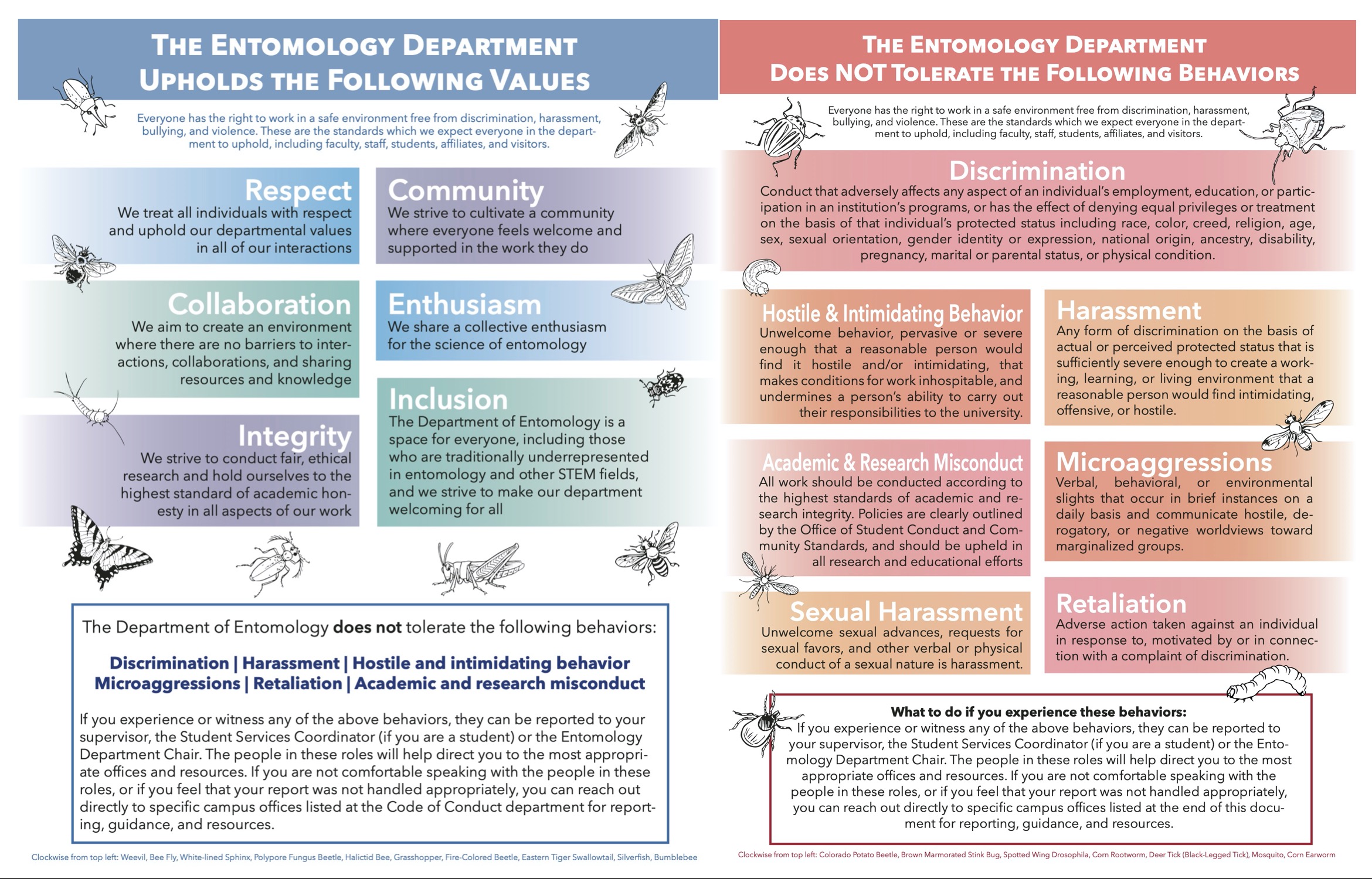
Our department upholds the following values:
- Inclusion: the Department of Entomology is a space for everyone, including those who are traditionally underrepresented in entomology and other STEM fields, and we strive to make our department welcoming for all
- Integrity: we strive to conduct fair, ethical research and hold ourselves to the highest standard of academic honesty in all aspects of our work
- Honesty: we hold honesty and integrity in interpersonal interactions as core values in our department
- Collaboration: we aim to create an environment where there are no barriers to interactions, collaborations, and sharing resources and knowledge
- Community: we strive to cultivate a community where everyone feels welcome and supported in the work they do
- Enthusiasm: we share a collective enthusiasm for the science of entomology
- Respect: we treat all individuals with respect and uphold values described in this document in all of our interactions
The following behaviors are not acceptable in our department:
- Discrimination: “Conduct that adversely affects any aspect of an individual’s employment, education, or participation in an institution’s activities or programs, or has the effect of denying equal privileges or treatment to an individual on the basis of that individual’s protected status or another category” as defined in the campus policy, including, but not limited to, race, color, creed, religion, age, sex, sexual orientation, gender identity or expression, national origin, ancestry, disability, pregnancy, marital or parental status, or any other category protected by law, including physical condition or developmental disability.
- Harassment: form of discrimination consisting of unwelcome verbal, written, graphic or physical conduct, directed at an individual or group on the basis of actual or perceived protected status, or affiliation/association with person(s) within a protected status and that is sufficiently severe or pervasive enough to interfere with employment, education/academic environment or participation in institution programs or activities and creates a working, learning, or living environment that a reasonable person would find intimidating, offensive, or hostile.
- Hostile and intimidating behavior: Unwelcome behavior, pervasive or severe enough that a reasonable person would find it hostile and/or intimidating, that makes conditions for work inhospitable, and undermines a person’s ability to carry out their responsibilities to the university.
- Microaggressions: Brief and commonplace daily verbal, behavioral, or environmental slights, whether intentional or unintentional, that communicate hostile, derogatory, or negative indignities toward marginalized groups.
- Sexual harassment: Unwelcome sexual advances, requests for sexual favors, and other verbal or physical conduct of a sexual nature constitutes sexual harassment when (1) submission to such conduct is made either explicitly or implicitly a term or condition of an individual’s employment or educational experience or their participation in a University program or activity, (2) submission to or rejection of such conduct by an individual is used as the basis for employment, academic, or program-related decisions affecting such an individual, or (3) creates a hostile environment.
- Retaliation: Adverse action taken against an individual in response to, motivated by or in connection with an individual’s complaint of discrimination or discriminatory harassment, participation in an investigation of such complaint and/or opposition to discrimination or discriminatory harassment in the educational or workplace setting.
- Academic and research misconduct: All work should be conducted according to the highest standards of academic and research integrity. Policies are clearly outlined by the Office of Student Conduct and Community Standards, and should be upheld in all research and educational efforts.
What to do if you experience unacceptable behaviors:
If you experience or witness any of the above behaviors, they can be reported to your supervisor, the Entomology Director of Graduate Studies, the Entomology Department Chair, Russell Labs Student Services Coordinator, Russell Labs Department Administrator, Russell Labs or CALS Human Resources Personnel. The people in these roles will help direct you to the most appropriate offices and resources. If you are not comfortable speaking with the people in these roles, or if you feel that your report was not handled appropriately, you can reach out directly to specific campus offices listed at the end of this document for reporting, guidance, and resources.
The Department of Entomology is committed to continue learning and educating ourselves about racism, ethnic/racial oppression, implicit bias, and inequalities that are pervasive in academia to continuously improve the culture in academia.
We also commit to continued departmental learning and training regarding microaggressions, which are less overt than the other behaviors outlined above. We are all responsible for creating a culture where microaggressions are not tolerated.
Reporting: Faculty and students are to follow campus requirements for reporting any of these behaviors. There are different reporting obligations mandated by the UW-Madison Office of Compliance and every employee is asked to review their responsibilities for mandatory reporting. The Entomology Department Chair, Russell Labs Academic Advising Manager, Russell Labs Department Administrator, Russell Labs or CALS Human Resources Personnel, and all Entomology faculty are mandatory reporters of sexual harassment.
Department-wide issues: If you experience an issue that relates to the whole department, students should discuss the issue with the Entomology Graduate Student Association (EGSA) and the president of EGSA should bring the issue to the department chair or the Entomology Director of Graduate Studies to present at the next faculty meeting. Alternatively, the student experiencing the issue could directly contact the Entomology Director of Graduate Studies or the department chair. Faculty and staff experiencing an issue should discuss the issue with the department chair.
Last updated: