

Education & Background:
P.D. Student in Entomology, University of Wisconsin-Madison
2014, M.S. Biological Sciences, University of the Pacific
2010, B.A. Integrative Biology, University of California, Berkeley
Awards and Grants:
2016 Theodore Roosevelt Memorial Fund Scholarship
2016 Mauel Award Fund on Research in Lepidoptera
2014 Lillian and Alex Feir Distinguished Fellowship in Entomology, UW-Madison
2013 Pacific Fund Grant, University of the Pacific
2012 Eberhardt Research Fellowship, University of the Pacific
2006-10 The Achievement Award Program Scholarship, UC Berkeley
Research Interests:
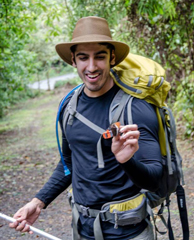
Hi everyone! I’m Khuram Zaman, born and raised in Stockton, CA. I am an incoming PhD student joining Dr Sean Schoville’s Molecular Ecology Lab at UW Madison. At the University of the Pacific, I worked in Dr. Ryan Hill’s lab the last three years for my Masters, studying the natural history and population dynamics of an imperiled butterfly species, Speyeria adiaste clemencei in Monterey Co, CA. I had always had a love for wildlife and being outdoors so I came to Dr. Hill because of the field work that would be possible by working in his lab. Before joining the lab, I didn’t have any previous experience working with butterflies, but in the time since, I have come to really enjoy working with this group. The diversity of butterflies and their myriad phenotypes and morphology in both the larval and adult forms is one of their most interesting aspects.
I will continue to use butterflies as a model system by working with Parnassius clodius butterflies with Dr. Schoville, particularly looking at how ecology can drive speciation, at an incipient stage of genetic divergence. I am interested broadly in topics in ecology and evolution, and more specifically, studying the processes that can potentially lead to speciation by using a combination of extensive field studies and lab experiments.