
Land Acknowledgement Workshop & Resources
This series was hosted by the Entomology and Horticulture DEI committees, represented by Hanna McIntosh, Amaya Atucha, Beth Workmaster, Christelle Guédot, Claudia Calderon, Guolong Liang, Linda Crubaugh, Skye Harnsberger, and Willow Lovecky. Information about the workshops as well as recordings and select resources for further exploration of this topic have been compiled by the committees and are shared below.
Part 1: How to learn the history of stolen land
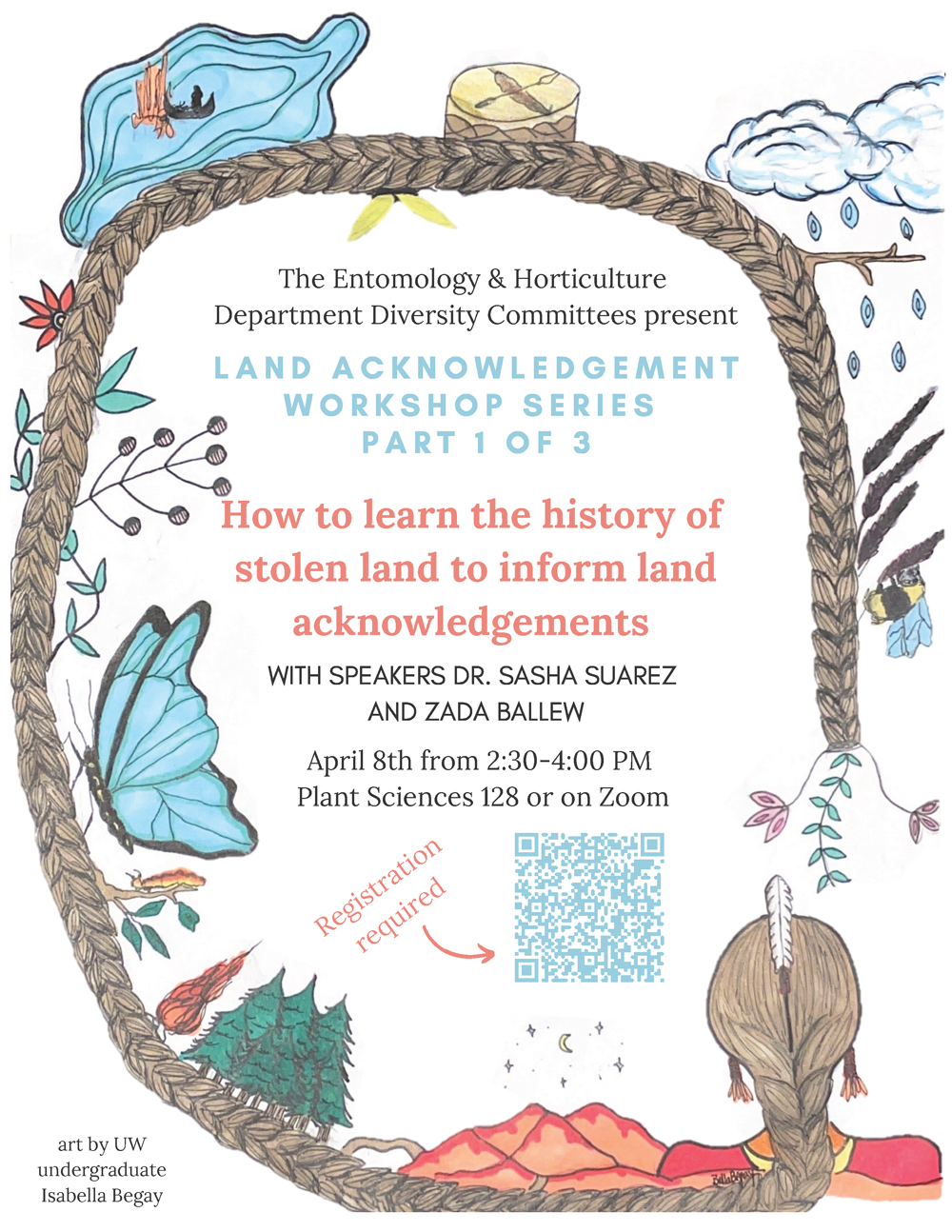 Speakers Dr. Sasha Suarez and Zada Ballew provided us with tools to begin to learn the Indigenous history of the land we occupy, regardless of where we live. The resources for Part 1 focus on learning whose land you’re on and understanding the history of Land Grab Universities.
About the speakers:
Dr. Sasha Suarez is an assistant professor in the UW-Madison History Department and Program of American Indian Studies and is a scholar of Indigenous history in the Great Lakes region. Her work examines the gendered practices of place-making, community organizing, and activism among White Earth Ojibwe in an urban environment from the 1920s to the 1970s. Her research interests include Indigenous social movements and urban histories, with a specificity on Indigenous cultural, communal, and political continuity. Dr. Suarez is a White Earth Ojibwe descendent.
Zada Ballew is a graduate student in the UW-Madison History Department. Her research, writing, and teaching centers Native histories, Indigeneity, storytelling, Land, water, memory, mythmaking, and survivance (survival + resistance). Her current project chronicles a forgotten history of Land claims and land acknowledgments involving her tribe, the Pokégnek Bodéwadmik (Pokagon Band of Potawatomi) and settlers at the turn of the twentieth century.
Resources:
- Workshop recording
- Speaker slides: How to learn the history of stolen land workshop Resources Slides
- A guide to Indigenous Land Acknowledgement (Native Governance Center)
- Confronting the Wealth Transfer from Tribal Nations That Established Land-Grant Universities (American Association of University Professors)
- Land-Grab Universities maps & data (High Country News)
- Land-Grab Universities article (High Country News)
- Native land digital map
- Indigenuity & Teejop: a Discussion with Samantha Skenandore (full version of the video clip we watched in the beginning of the presentation)
Part 2: How to engage in the process of land acknowledgement
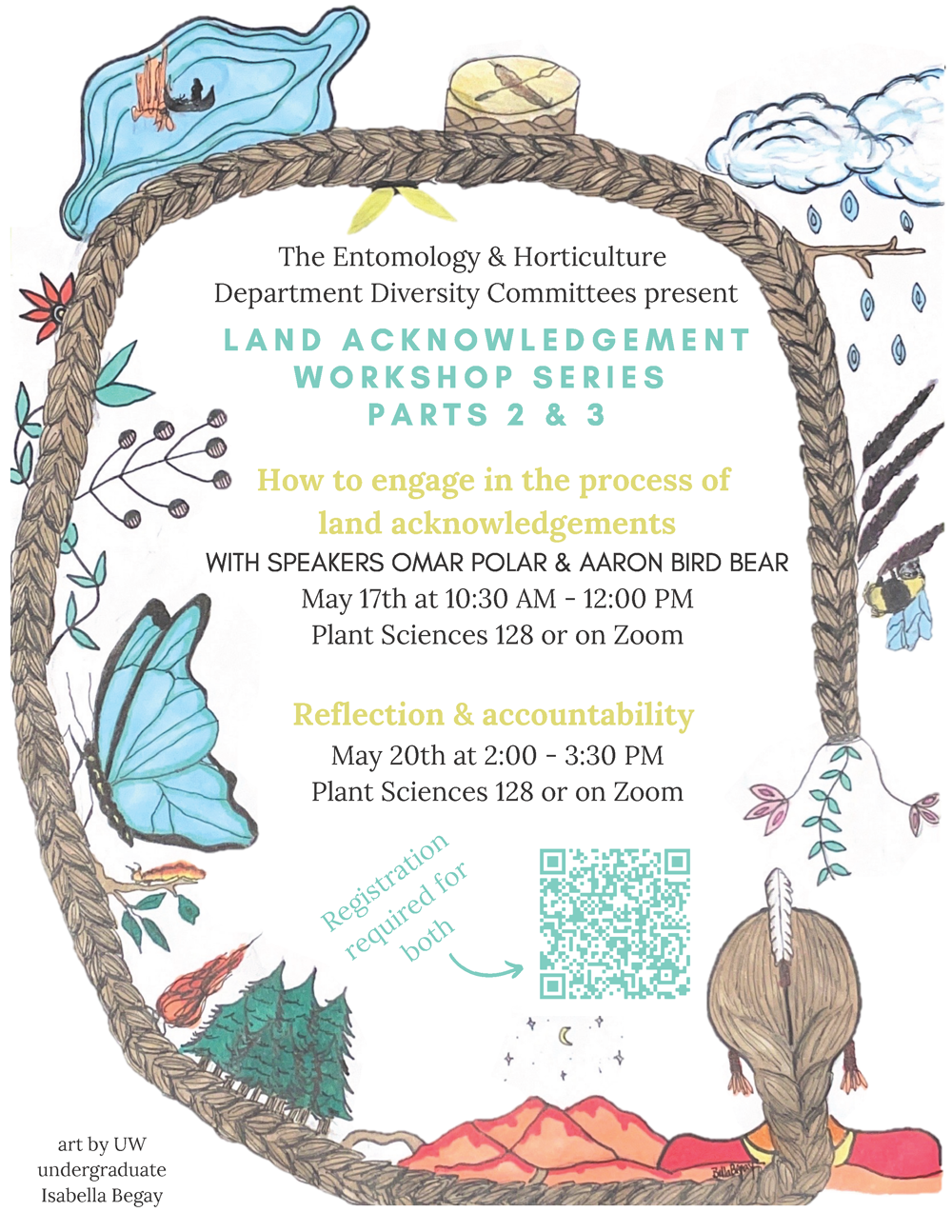 Speakers Aaron Bird Bear and Omar Poler provide us with the tools to begin the process of land acknowledgement. The resources for Part 2 focus on best practices for land acknowledgements, and provide examples of initiatives for reconciliation at other universities and Land Back projects.
About the speakers:
Aaron Bird Bear is the first Director of Tribal Relations at UW-Madison, where he works to facilitate communication and strengthen relationships between UW-Madison and the First Nations of Wisconsin. Aaron is a leader in the Native Nations UW Working Group, helped develop the UW-Madison First Nations Cultural Landscape Tour, and co-leads the Our Shared Future Initiative. Aaron is a citizen of the Mandan, Hidatsa & Diné Nations (enrolled in the Three Affiliated Tribes of the Fort Berthold Indian Reservation).
Omar Poler is the American Indian Curriculum Services Coordinator at the Teacher Education Center at UW-Madison. He supports the integration of American Indian history, culture, and tribal sovereignty into PK-16 education required by Wisconsin Act 31. Omar leads place-based learning through the UW-Madison First Nations Cultural Landscape Tour, co-created the Tribal Libraries Archives and Museums Project, and served as an Outreach Specialist for the UW-Madison Information School. Omar is an enrolled member of the Sokaogon Chippewa Community.
Resources:
- Workshop recording
- Speaker slides
- Example land acknowledgements (used in the small group activity in the workshop)
- Collaborative reflection doc: Land Acknowledgement Workshop Part 2 Questions
- Process of land acknowledgement
- Land Acknowledgement Guidance (UW Tribal Relations)
- A Guide to Indigenous Land Acknowledgement (Native Governance Center)
- Are you planning to do a Land Acknowledgement? (Debbie Reese)
- Action
- Wokini Initiative (South Dakota State, returns Morrill funds to Indigenous students / programs)
- Stepping Out & Stepping Up: Toward Truth & Reconciliation with Dispossessed Native American Tribes (The Ohio State)
- Land Back projects (compiled by UW-Madison Professor Dr. Jen Rose Smith)
- On Stolen Land: Beyond Land Acknowledgements (Red Madison)
- Cornell University & Indigenous Dispossession Project
Part 3: Reflection & accountability
The Land Acknowledgement Workshop Committee led the group in a series of reflection questions and discussions about their relationship with the land they do research on, the beings they study, and Indigenous people. This workshop was not recorded, but we strongly encourage you to answer the reflection questions yourself.
Resources:
- Reflection questions & collaborative responses (please feel free to add your thoughts to the document): Land Acknowledgement Workshop Part 3 Questions
- Native Nations UW Working Group
- Developing Stamina for Decolonizing Higher Education: A Workbook for Non-Indigenous People
- A Push for Conversation: Ecology, Place-based Research, and Land Acknowledgements (zine created by committee member Willow Lovecky, including a resource guide)
Recent posts »
- Entomology Digest – Spring 2026
- New bug-tracking project aims to help monitor health of Wisconsin waterways
- UW Entomology students Victoria Salerno and Sophie Perry recognized at ESA
- Dr. Emily Bick receives International Date Palm Prize
- Invasive tree-killing pest ‘highly likely’ to show up in Wisconsin, expert says